

Download the Handout
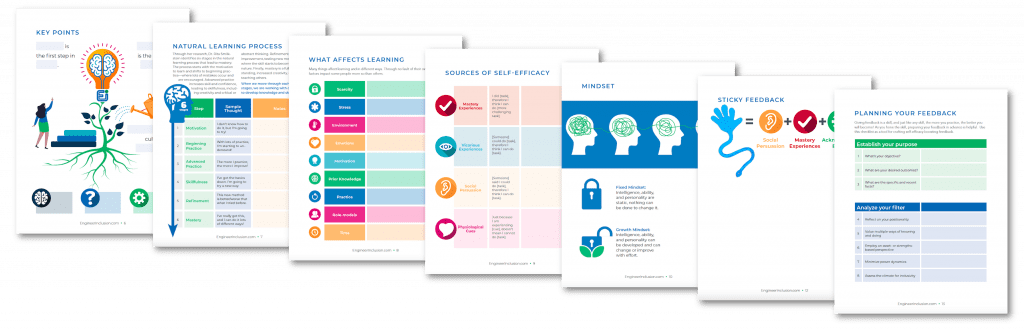
Key Terms
>> SEE PAGE 2 of HANDOUT <<
- To prepare for the lessons ahead, please review the following list of key terms.
- Reflect on which terms are new for you.
- Leave a comment to share which key term stands out to you and why?

- Asset Mindset: An asset perspective is when we view participants’ cultural differences as beneficial to the learning environment, as opposed to a deficit perspective, where cultural differences are perceived as detrimental to the learning environment. Educators with asset perspectives are more likely to innovate instruction, while those with deficit perspectives are more likely to have lower expectations for marginalized students.
- Equity: Equity is the dismantling of systemic and institutional barriers, and giving people what they need to succeed.
- Implicit Bias: Implicit bias refers to the attitudes or stereotypes that affect one’s understanding, actions, and decisions in an unconscious manner. These are often unrecognized and may not align to one’s declared beliefs and values.
- Marginalized Group: Marginalization is the treatment of a person, group, or concept as insignificant or peripheral. Marginalized groups refer to individuals who are consistently confined to the lower or peripheral edges of society or groups because they are commonly seen as different from perceived norms and dominant culture.
- Mindset: Mindset is a self-perception that people hold about themselves that affects how they approach tasks. Fixed Mindset: Intelligence, ability, and personality are static, nothing can be done to change it. Growth Mindset: Intelligence, ability, and personality can be developed and can change or improve with effort.
- Positionality: Positionality is the social and political context that creates your identity and how your identity influences and biases your perception of and outlook on the world.
- Self-efficacy: Self-efficacy is a belief in oneself that they can accomplish a task. It answers the question, “Can I do this?” High self-efficacy predicts academic achievement, while high self-esteem does not.
** For a more comprehensive glossary, visit Engineer Inclusion’s list of key terms.
Part 1: Roadmap & Primer Question
Part 2: What have you mastered?
Part 3: Natural Human Learning Process
Part 4: What affects learning?
Part 5: Sources of Self-efficacy
Activity
>> SEE PAGE 6 of HANDOUT <<
 There are four sources of self-efficacy. Below you will find simple formulas for each.
- Mastery Experiences: I did [task], therefore I think I can do [more challenging task].
- Vicarious Experiences: [Someone] could do [task], therefore I think I can do [task].
- Social Persuasion: [Someone] said I could do [task], therefore I think I can do [task].
- Physiological Cues: Just because I am experiencing [cue], doesn’t mean I cannot do [task].
Part 6: Mindset
Part 7: Characteristics of Effective Feedback
Part 8: Filters influence our feedback
Part 9: Sticky Feedback
Part 10: Planning Your Feedback
Strategies for boosting self-efficacy and mindset
>> SEE PAGE 12 of HANDOUT <<

Whether you are trying to boost your self-efficacy and mindset, or those around you, here are six research-based strategies to help.
- Breakdown the task
- Find a role-model
- Ask for feedback and help
- Learn from mistakes
- Celebrate milestones
- Build the courage to start
Reflection & Action Planning
>> SEE PAGE 15 of HANDOUT <<
Take time to reflect on what you learned and make a plan for action. This lesson provides questions to guide you.

Reflection Questions
- What are your top three takeaways?
- What did you learn that challenged what you previously thought?
- What do you still want to know? (How will you find those answers?)
Action Planning Questions
- How will you use the planning your feedback tool to help you improve your skill?
- How can you employ the other strategies for boosting self-efficacy and mindset in your practice?
Discussion
Share what you learned and engage with others who are learning alongside you.

Discussion questions
- What questions do you have based on what you learned?
- What else would you like to add to help others who are learning with you?
- Do you have any complimentary resources that would add value to the community?
- Share results from your action plan. What did you try? What did you learn from that experience?


